Every great D&D campaign starts with a world that feels real — not a setting that exists only on paper, but a place your players can push against, explore, and change. Building that world from scratch is one of the most satisfying parts of DMing, and it doesn't require writing a novel before session one.
This guide covers the fundamentals of worldbuilding: how to start, what to prepare, what to leave open, and how AI tools can help you build faster without losing the creative ownership that makes your world yours.
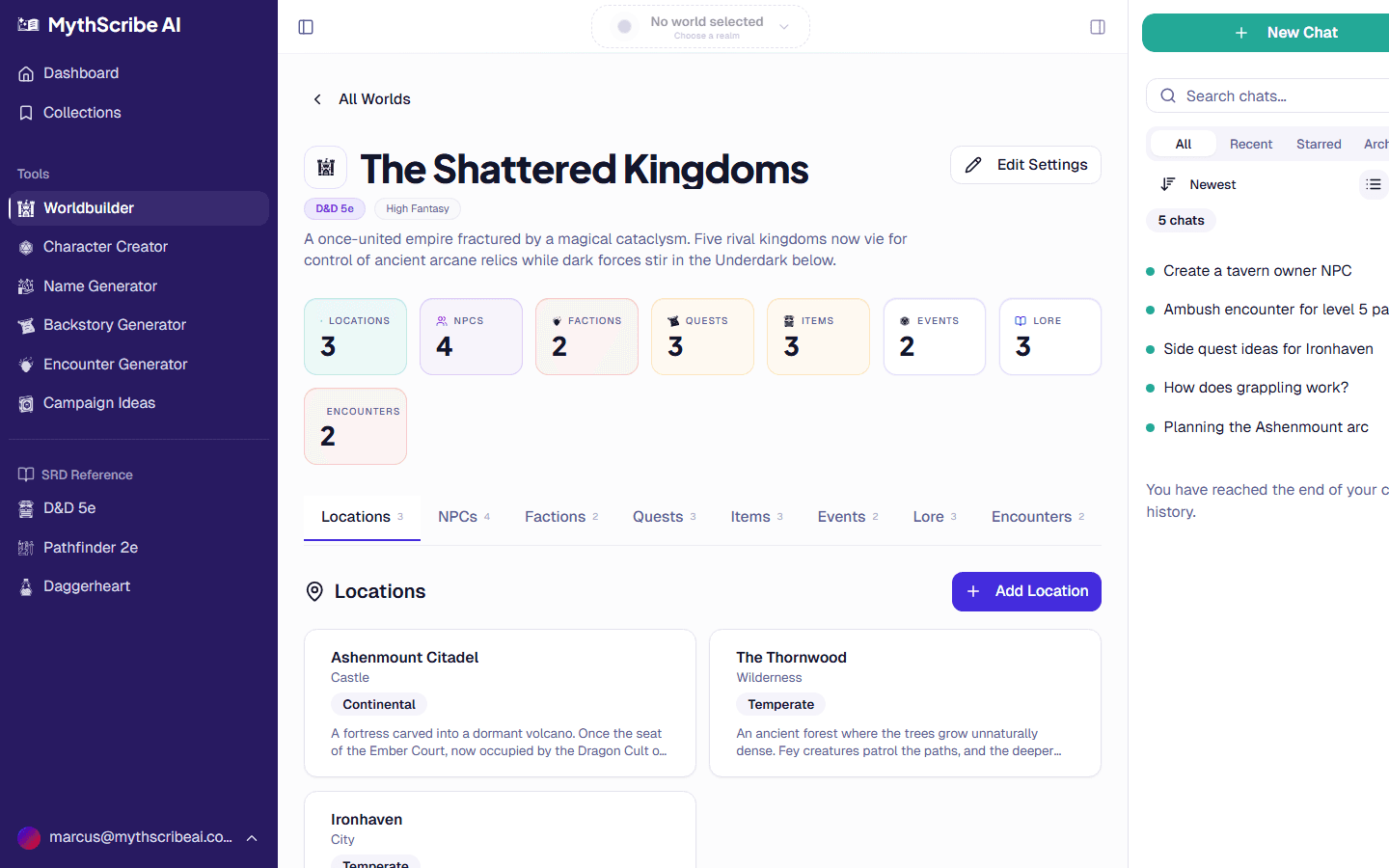 Worldbuilder dashboard with structured entities
Start with Tone, Not Geography
Most worldbuilders start by drawing a map. That's fine, but it's not the most important first step. Before you know where anything is, you need to know what your world feels like.
Ask yourself one question: What is the central tension of this world?
Some examples:
- An empire in slow collapse, its provinces fracturing into city-states
- A world where magic is newly discovered and destabilizing existing power
- A frontier world, recently settled, where civilization is still defining its edges
- A world recovering from a cataclysm that happened 200 years ago
This central tension shapes everything — what factions exist, what people are afraid of, what your players can change. Without it, you have geography and history but no story waiting to happen.
The Minimum Viable World
You don't need a fully realized world for session one. You need enough to play in. Here's a useful minimum:
One region. A single area your players will operate in for the first 3-5 sessions. A city and its surroundings, a frontier province, a valley. You can leave everything outside it as vague shapes on a map.
Two to three factions. Groups with competing interests that exist in your region. They don't need elaborate histories — just a goal, a rival, and a reputation. Factions give players things to navigate, work for, and antagonize.
One looming threat. Something bad that's coming or already happening. Could be political (a power vacuum), environmental (the harvest failing), supernatural (a dungeon that's been sealed for a century just opened), or personal (someone powerful wants something the party has).
Five NPCs with names. Not backstories — just names and one-sentence descriptions. "Veleth, the harbormaster — takes bribes but runs the docks with ruthless efficiency." You'll discover who they are at the table.
That's enough. Everything else gets built in response to what your players do.
Building History That Feels Real
The history of your world should feel lived-in, not curated. The key is that history has losers — things that were destroyed, suppressed, or forgotten. A world where everything worked out is a museum. A world with ruins, grudges, and contested narratives is a living place.
Practical technique: The Three Layers
-
Myth-age (1,000+ years ago): Vague, legendary, unreliable. The gods walked the earth, a great empire rose and fell, magic worked differently. Players can discover fragments but never the full truth. This is your lore hook layer.
-
Historical (100-500 years ago): Documented but contested. Wars, dynasties, conquests. The current world is built on these events. Someone alive knew people who lived through this.
-
Living memory (within 50 years): People remember this. There are survivors. The consequences are still playing out. This is where your factions got their grievances.
Each layer should raise at least one question that players might want to investigate. Questions are more valuable than answers.
Factions: The Engine of Political Drama
Factions are the most reliable engine for generating story in a sandbox world. When factions have competing goals, they create situations that don't require the DM to push — the world generates conflict on its own.
Every faction needs:
- A goal — what they want to get or protect
- A method — how they typically pursue it (violence, politics, money, religion, secrecy)
- A rival — who is standing in their way
- A public face and a private face — what the world thinks of them vs. what they're actually doing
Example faction build:
The Iron Covenant — a merchants' guild that controls most trade in the region.
- Goal: monopoly over the eastern trade routes
- Method: bribery, favorable contracts, and occasionally hired intimidation
- Rival: The Freeport Alliance (a loose coalition of smaller merchants)
- Public face: legitimate business association, major employer, funds city improvements
- Private face: actively suppressing a new caravan route that would break their monopoly
Three factions with goals and rivals give you enough for a full campaign without any additional plot. Put the players in the middle and see what they decide to do.
The Map: What to Prepare and What to Leave Open
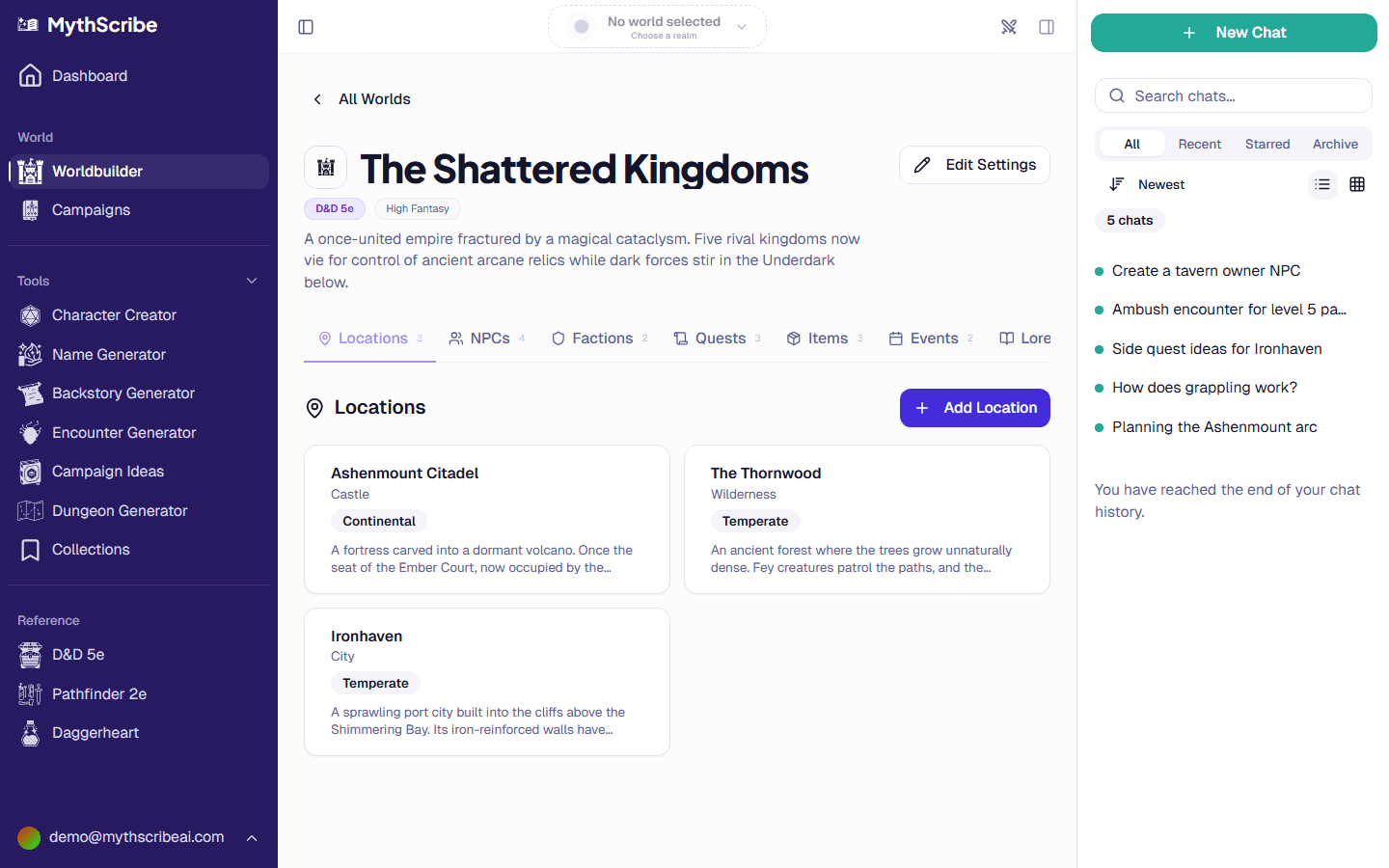 Worldbuilder locations tab with city and district cards
Maps are useful — they help you and your players understand space and distance. But maps can also be a trap: every detail you commit to is one more thing you have to justify.
What to map early:
- Major settlements (cities, towns, the places players will actually visit)
- Physical geography that affects travel (mountain ranges, rivers, coastlines)
- The distance between places (approximate — you don't need exact miles)
What to leave unmapped:
- The interiors of wilderness regions
- Dungeons and ruins (until the party is heading there)
- Anything more than one region beyond where the campaign is currently set
A "fog of war" map isn't just a gameplay tool — it reflects the reality that no character would have comprehensive knowledge of an unexplored world. Leave room to be surprised by your own world.
One trick that works: Draw your map, then pick three or four locations and label them "Ruins of ___" or "The ___ Wilds" without deciding what they are. These become improvisation anchors. When you need a location, you already have names for places that exist.
Religion and Magic: Keep It Functional First
Religion and magic systems are two areas where worldbuilders tend to over-engineer. You don't need a complete theology or a magic theory before you play.
For religion: Start with what it does at the table. Religion is a source of healing, faction affiliation, moral conflict, and visual flavor. You need: what gods are active in this region, what they want from followers, and how clerics and paladins interact with the divine. The cosmology can come later.
For magic: Start with what players experience. Is magic common or rare? Feared or celebrated? What can't it do? The interesting questions are about limits and costs, not the underlying mechanism.
Both benefit from the same principle: establish what players interact with, leave the rest open.
Making the World React
The single most important worldbuilding skill for actual play is making the world respond to what players do. A world that continues unchanged regardless of player action is not a living world.
Practical tools for reactive worldbuilding:
Faction advancement. After each session, advance each faction one step toward its goal as if the players don't exist. Then apply what the players did. Did they expose the Iron Covenant's caravan sabotage? That changes the advancement. Did they ignore it? The Covenant quietly succeeds.
NPC consequences. When the party makes an enemy, that enemy doesn't disappear. They hire guards, spread rumors, stop sharing information, or wait for an opportunity. When the party makes a friend, that friend has their own needs and limitations.
Environmental change. If there's a drought, it gets worse unless addressed. If the dungeon was left unsealed, something moved in. The world doesn't pause while the players are elsewhere.
This requires minimal prep — just a brief end-of-session note: "What changed? What did the party set in motion?"
Using AI Tools for Worldbuilding
AI tools are most useful for the parts of worldbuilding that are repetitive or require depth you don't have time to create manually.
Best uses:
NPC generation — the MythScribe Worldbuilder generates NPCs with names, personality traits, motivations, and secrets. It's context-aware if you've built your world in the tool, so NPCs reference your actual factions and geography.
Location descriptions — describing the seventeenth tavern or the third dungeon level starts to feel like churn. AI can generate varied location details quickly.
Faction backstory — you know what a faction wants; AI can help you generate the history of how they got there and what their internal conflicts look like.
Encounter building — the Encounter Generator produces CR-balanced combat encounters for any environment and any of the three supported game systems.
Where AI doesn't help: The central tension of your world, your unique aesthetic sensibility, the things that will resonate with your specific players. Those are yours. AI is a texture generator, not a vision generator.
Common Worldbuilding Mistakes
Building more than you'll use. The elaborate northern kingdom you mapped out may never appear in the campaign. Build forward, not outward — what's next for the party, not what's on the other side of the continent.
Making everything important. If every location has a secret and every NPC has a backstory, nothing feels significant. Reserve depth for things players will actually spend time on.
Solving every mystery. The most compelling worldbuilding questions are the ones that don't have answers yet. Let some things be genuinely unknown.
Fixing mistakes instead of incorporating them. When you contradict yourself or a player finds a plot hole, the instinct is to retcon. A better instinct: make it part of the world. "Maybe things are more complicated than they appeared" is always true in a real world.
Frequently Asked Questions
How long should I spend on worldbuilding before starting a campaign? Enough to have a central tension, one region, two or three factions, and five named NPCs. For most DMs that's two to four hours. You'll build the rest during the campaign.
Do I need to create a fully original world? No — running in an established setting (Forgotten Realms, Eberron, Golarion) is completely valid. Worldbuilding is about understanding your setting well enough to run it dynamically, not necessarily creating it from scratch.
How do I keep players from breaking my world? You don't — and you shouldn't want to. Players breaking your plans is the game working. Build a world that's resilient enough to keep making sense when they do unexpected things.
What's the most important worldbuilding skill? Asking questions rather than providing answers. "What happened to the old ruling family?" is more generative than having a complete answer. Let some mysteries stay mysterious until the campaign makes them relevant.
Try These Tools Free
Put what you just read into practice.