Session prep is the part of DMing that kills campaigns. Not the actual sessions — those are usually great. It's the Tuesday night before game day when you're staring at your notes wondering how you're going to stat up six NPCs, design three encounters, and write the next chapter of the story while also being a functioning adult.
AI tools have changed this. Not by making prep unnecessary — you still need to know your players, remember what happened last session, and have a sense of the story's direction. But they cut the mechanical drudgery by 80%, which means you can focus on what actually makes your sessions good.
Here's exactly how to run a session prep in 15 minutes using AI tools.
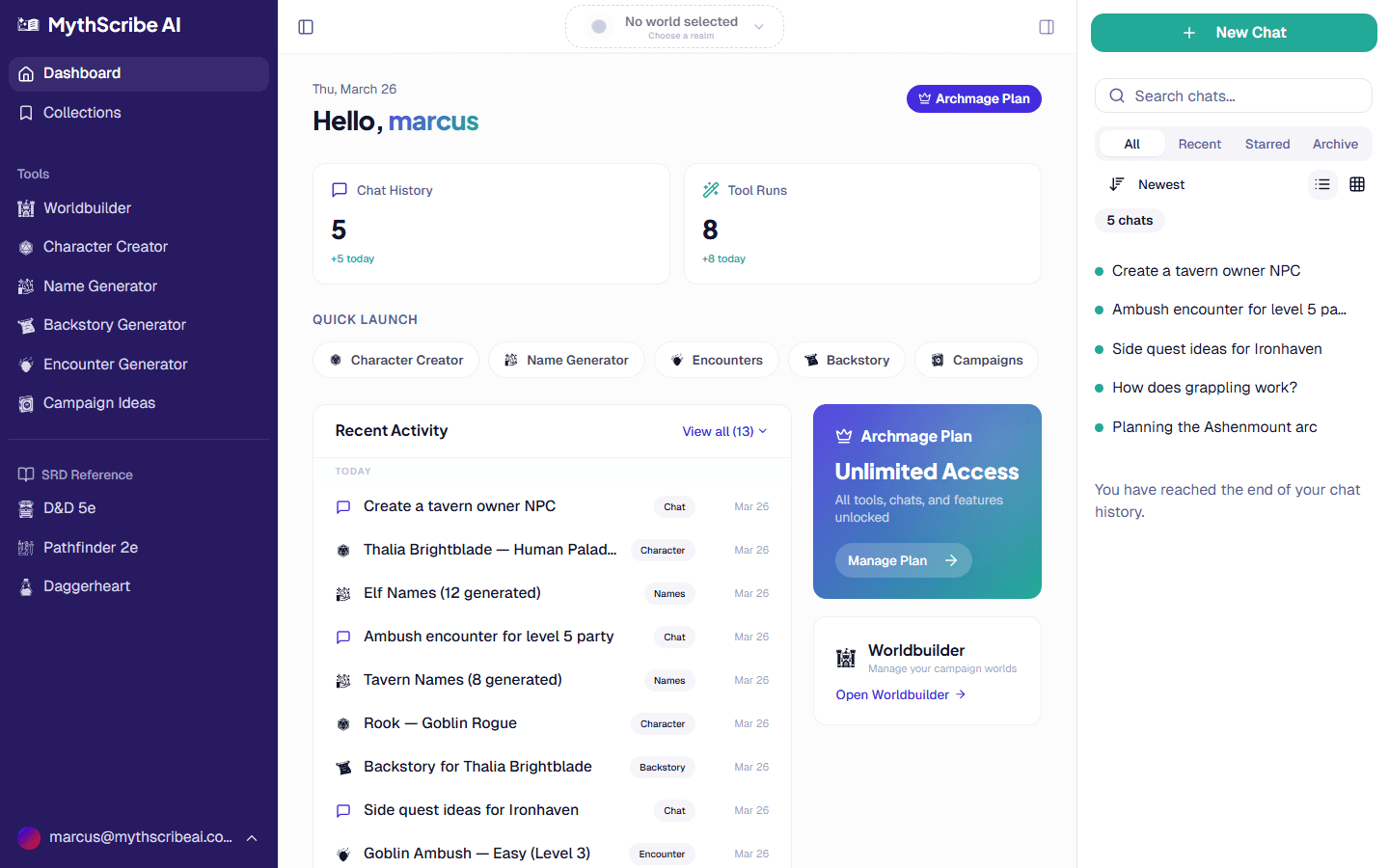 MythScribe dashboard with all session prep tools
Before You Start: The 3-Question Framework
Before opening any tool, answer these three questions:
- What do the players want from this session? (Combat? Roleplay? Investigation? A mix?)
- What has to happen for the story to progress? (One or two beats, not a full outline)
- What will surprise them? (One thing they won't see coming)
Write these down. They take 2 minutes and are the entire foundation of a good session. Everything you generate after this serves these answers.
Minutes 1-5: Generate the Encounter
Start with the combat encounter if you're having one. This is the highest-stakes mechanical prep — getting the CR wrong wastes everyone's time.
What to give the generator:
- Party size and level
- Game system (D&D 5e, Pathfinder 2e, Daggerheart)
- Environment (dungeon corridor, forest clearing, city rooftop, etc.)
- Tone (ambush, set-piece battle, desperate escape)
The MythScribe Encounter Generator produces CR-balanced enemy groups, XP budgets, difficulty ratings, loot tables, and tactical suggestions. What used to take 20 minutes of manual CR math takes 30 seconds.
What to add yourself:
- One twist (the enemies are guarding something, not just attacking)
- One environmental feature (a chandelier to drop, a chasm to push enemies into)
- One escape route (so the encounter has a non-lethal resolution)
Total time: 3-4 minutes.
Minutes 5-10: Create the Key NPCs
Most sessions have 2-3 NPCs the party will meaningfully interact with. For each one, you need:
- A name
- One want (what they're trying to get or keep)
- One secret (what they're hiding or don't know they know)
- One quirk (how you'll perform them at the table)
Using the MythScribe Worldbuilder:
If you've set up a world in the Worldbuilder, you can generate NPCs that are context-aware — the AI knows your world's factions, political tensions, and geography, so NPCs it creates actually fit your setting.
For NPCs without world context, the character generator still produces names, personality traits, and motivations in seconds. Take what fits, discard what doesn't.
What to add yourself:
- Their connection to the party (have they met before? Does an NPC know something about a player character's backstory?)
- A voice note to yourself (3 words about how you'll physically play them — slow speech, nervous laugh, military posture)
Total time: 4-5 minutes.
Minutes 10-13: Sketch the Session Structure
You don't need a complete outline. You need a skeleton:
Opening hook (1 sentence): How does the session start, and what's the immediate problem? "The party wakes to fire bells — someone is burning the merchant district."
Middle complication (1 sentence): What makes the obvious solution harder? "The fire was set as a distraction for a warehouse robbery — but the warehouse is where the party stored their gear."
Possible ending (1 sentence): What does success (or failure) look like? "Either they catch the thief and recover the gear, or they lose it and the thief gives them a clue to a larger plot."
Three sentences. That's your session plan. AI tools can help you expand any of these if you need more detail — the AI Chat assistant is useful for bouncing "what if" scenarios before the session.
Total time: 3 minutes.
Minutes 13-15: Prep the One Surprise
This is the most important 2 minutes of prep, and it has nothing to do with AI tools.
Think of one thing that will surprise your players — something that changes an assumption they've been operating on. Some examples:
- The villain they've been hunting is already dead; someone is impersonating them
- The helpful NPC they trust is being blackmailed
- The dungeon they're exploring is actually inside a sleeping giant
- One player character's backstory connection shows up in the worst possible moment
Write it down. Don't prepare it fully — just know it exists. Surprises are more powerful when they emerge naturally from play rather than being forced.
What AI Does Well
Mechanical generation. Encounter balancing, stat blocks, loot tables, and name generation are all things AI tools do faster and more accurately than manual calculation. This is pure time savings.
Worldbuilding scaffolding. Generating consistent NPC names, faction relationships, and location descriptions for a setting you're building takes hours manually and minutes with AI. The Worldbuilder lets you link all these pieces so the AI has context when generating new content.
Backstory and personality traits. The Backstory Generator produces multi-paragraph character backstories with personality traits, ideals, bonds, and flaws. Useful for player characters who struggle with that part of creation, and for NPCs who need more depth.
Campaign arcs and quest hooks. The Campaign Ideas Generator produces full campaign arcs, villain backstories, and quest hooks. Great for when you need a new thread to introduce into an existing campaign without planning a full arc from scratch.
What AI Doesn't Do Well
Knowing your table. AI doesn't know that one of your players will be devastated if their character's mentor dies, or that your group finds a certain type of humor hilarious. Prep time is when you apply that knowledge to the AI's output.
Remembering what happened last session. You need to bring this context. The more specific context you give the AI, the more useful its output. "Generate an NPC" gives you a generic character. "Generate a halfling fence who owes a debt to the thieves' guild that the party disrupted last session" gives you something you can actually use.
Improvising at the table. AI prep helps you prepare — but the best moments in D&D are unplanned. The AI-generated encounter is a framework; the emergent moment when the paladin offers to surrender instead of fighting is not something any tool can generate for you.
Replacing the fun of prep. Some DMs love the creative process of prep — the worldbuilding, the NPC voices, the elaborate dungeon design. If you're one of those DMs, AI tools are useful accelerators, not replacements. Use them where they save you time on things you find tedious, not on things you enjoy.
A Sample 15-Minute Prep Session
Session premise: The party is investigating disappearances in a port city. Last session they learned the victims all visited the same tavern before vanishing.
Question framework:
- Players want: investigation + roleplay, with one combat at the end
- Story beat: they discover the tavern owner is complicit, not the mastermind
- Surprise: the tavern owner is one of the original victims — magically coerced
Encounter (4 min): Encounter generator → 4th level party of 5 → Medium difficulty → urban rooftop chase with 3 thugs and a shadow who is clearly not human.
NPCs (4 min):
- Tarvel, the tavern owner: wants safety for his daughter, hiding magical compulsion markings on his wrists, speaks softly and avoids eye contact
- The Harbor Master: wants to end the investigation quietly, secret is that she's being bribed, taps her signet ring when nervous
Structure (3 min):
- Open: tavern owner confronts the party preemptively, warns them off
- Complication: documents in the tavern back room prove coercion, not guilt — but they're in a locked chest
- End: rooftop pursuit of the real agent, who escapes with a calling card
Surprise (2 min): The calling card is the symbol of a thieves' guild the party destroyed in session 3. Someone rebuilt it, and they're angry.
Total: 13 minutes. Ready to run.
Frequently Asked Questions
Will players notice that I used AI for prep? No — the output you use is filtered through your knowledge of your table, your setting, and your story. AI is prep infrastructure; what happens at the table is still your game.
Can AI replace prep entirely? Not yet, and probably not ever for the parts that matter. AI is excellent at the mechanical and scaffolding work. The judgment calls — what your players need, what serves the story — still require you.
What if I disagree with what the AI generates? Discard it. Everything the generator produces is a suggestion. Take what's useful, change what doesn't fit, and throw away the rest. The goal is faster, not hands-off.
Is this cheating? Using a calculator to add up XP isn't cheating. Using a random encounter table isn't cheating. Using an AI tool to generate that table faster isn't cheating. You're still the DM. You're still making the calls that matter.
Try These Tools Free
Put what you just read into practice.