Building your first D&D character can feel overwhelming when you're staring at a blank character sheet. This guide walks you through every step in order — from picking your race to writing your backstory — so you can sit down at your first session feeling confident.
What You Need
Before you start, grab:
- A D&D 5e character sheet (free at dndbeyond.com or just print one)
- A set of dice (or a dice roller app)
- The Player's Handbook, or use the free Basic Rules at dndbeyond.com
- About 30-60 minutes
If you want to skip the manual math, the MythScribe Character Creator generates a complete character — stats, equipment, and backstory — in seconds for D&D 5e, Pathfinder 2e, and Daggerheart.
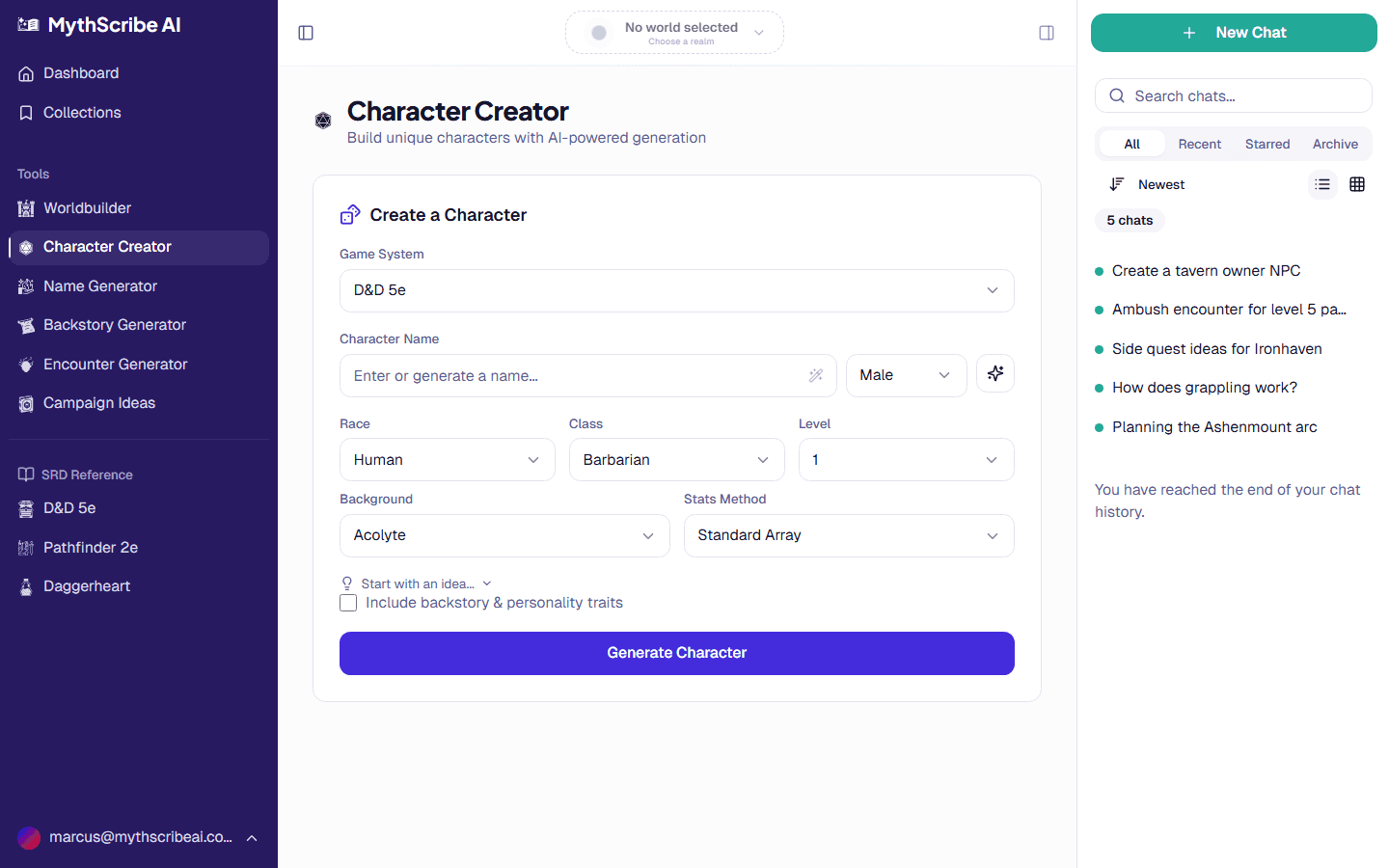 Character creator with filled ability scores and backstory
Step 1: Pick Your Race
Your race (officially called "species" in newer editions, but most tables still say race) determines some of your base traits and, in most cases, one or two ability score bonuses.
Popular races for beginners:
- Human — +1 to all ability scores, extra skill, extra feat (variant human). Flexible and fits any class.
- Elf — +2 Dexterity, advantage on charm/sleep saves, darkvision, free skill proficiency. Great for Rogues and Rangers.
- Dwarf — +2 Constitution, poison resistance, darkvision, proficiency with axes and hammers. Excellent Fighters and Clerics.
- Halfling — +2 Dexterity, Lucky trait (reroll 1s on attack rolls, ability checks, saving throws). Surprisingly powerful.
Don't stress this choice too much. Race bonuses matter less than class in D&D 5e, and most races work fine with most classes.
Step 2: Pick Your Class
Your class is the most important choice — it determines what you can do in combat, exploration, and roleplay situations.
Classes at a Glance
| Class | Role | Best for |
|---|---|---|
| Fighter | Weapon attacks, durability | Beginners, tactical players |
| Rogue | Damage spikes, skill checks, stealth | Players who love versatility |
| Cleric | Healing, armor, spells | Support players, divine themes |
| Wizard | Powerful spells, knowledge | Players who love options |
| Ranger | Nature magic, archery, exploration | Outdoor/survival themes |
| Paladin | Melee + healing + tanking | Players who want to do everything |
| Barbarian | High damage, tanking | Beginners who want to hit things |
| Druid | Shape-shifting, nature spells | Creative players |
| Bard | Support, skill master, decent spells | Social/roleplay-focused players |
| Warlock | Powerful but limited spells, eldritch blasts | Players who like interesting mechanics |
| Monk | Martial arts, ki points, speed | Players who like Eastern martial arts themes |
| Sorcerer | Flexible casting, metamagic | Players who want fewer spells but more control |
Recommendation for first-timers: Fighter or Cleric. Fighters are simple and effective. Clerics are flexible and your party will love you for keeping them alive.
Step 3: Choose Your Background
Your background represents what your character did before becoming an adventurer. It grants:
- Two skill proficiencies
- Tool or language proficiencies
- Starting equipment and gold
- A background feature (small roleplay benefit)
Good beginner backgrounds:
- Soldier — Athletics, Intimidation, a military rank that commands respect
- Criminal/Spy — Deception, Stealth, a criminal contact
- Sage — Arcana, History, ability to research lore
- Folk Hero — Animal Handling, Survival, people from your hometown know you
Choose based on the character concept you have in mind, not just the mechanics.
Step 4: Determine Ability Scores
The six ability scores are the foundation of your character:
| Ability | What It Affects |
|---|---|
| Strength (STR) | Melee attacks, carrying capacity, Athletics |
| Dexterity (DEX) | Ranged attacks, AC (without armor), stealth, initiative |
| Constitution (CON) | Hit points, concentration spells |
| Intelligence (INT) | Knowledge skills, Wizard spell attacks |
| Wisdom (WIS) | Perception, Insight, Cleric/Druid spell attacks |
| Charisma (CHA) | Social skills, Bard/Paladin/Warlock spells |
How to Assign Scores
The simplest method is the Standard Array: 15, 14, 13, 12, 10, 8. Assign these six numbers to your six ability scores however you like.
Point Buy gives you more control: you start with all scores at 8 and spend 27 points to raise them (each +1 costs 1 point up to 13, then 2 points per +1 to reach 15).
Rolling (4d6 drop lowest, six times) is exciting but can produce unbalanced characters. Many tables use the Standard Array to keep things fair.
Ability Score Priorities by Class
Put your highest scores here:
- Fighter/Barbarian: STR first (or DEX for finesse builds), CON second
- Rogue/Ranger: DEX first, CON second
- Wizard: INT first, CON second
- Cleric: WIS first, CON second
- Paladin: STR or DEX, CHA second
- Bard/Warlock/Sorcerer: CHA first, CON second
Step 5: Calculate Your Modifiers and Stats
Once you have your ability scores, calculate:
Ability modifier = (score - 10) ÷ 2, rounded down
| Score | Modifier |
|---|---|
| 8-9 | -1 |
| 10-11 | +0 |
| 12-13 | +1 |
| 14-15 | +2 |
| 16-17 | +3 |
| 18-19 | +4 |
| 20 | +5 |
Proficiency Bonus at level 1 = +2. This applies to any skill, attack, or saving throw you're proficient in.
Hit Points = max hit die + CON modifier at level 1:
- Barbarian: 12 + CON mod
- Fighter/Ranger/Paladin: 10 + CON mod
- Cleric/Druid/Monk/Rogue/Warlock: 8 + CON mod
- Bard/Sorcerer/Wizard: 6 + CON mod
Armor Class depends on your armor:
- No armor: 10 + DEX modifier
- Light armor (Leather): 11 + DEX modifier
- Medium armor (Chain Shirt): 13 + DEX modifier (max +2)
- Heavy armor (Chain Mail): 16 (no DEX bonus)
Step 6: Choose Your Skills
Skills are specific applications of ability scores. You're proficient in a skill if your class or background grants it — add your proficiency bonus (+2 at level 1) to those checks.
At level 1, you get proficiencies from:
- Your class (typically 2-4 skills from a class-specific list)
- Your background (2 skills, usually fixed)
- Your race (sometimes 1 skill)
Perception is the most-used skill in the game (it's your passive awareness of the world). If you have the option to take it, do.
Step 7: Pick Starting Equipment
Your class and background give you starting equipment. At level 1, this typically includes a weapon, armor, and some adventuring gear (torches, rope, rations).
Most classes let you choose between two packages. Common choices:
- Fighter: chain mail + a martial weapon + shield, OR leather armor + longbow + two handaxes
- Rogue: rapier, shortbow, leather armor, burglar's pack
- Wizard: quarterstaff, spellbook, scholar's pack
Alternatively, you can take starting gold and buy equipment from the PHB table. Beginners should just pick a package.
Step 8: Write Your Backstory
The backstory is optional mechanically but important for roleplay. A simple formula that works:
- Where are you from? (a city, a small village, the wilderness)
- What did you do before adventuring? (linked to your background)
- Why are you adventuring now? (something pushed you out of your normal life)
- What do you want? (a goal that can drive roleplay)
Your backstory doesn't need to be a novel. Two paragraphs is plenty for a first session. You can expand it as you learn who your character is at the table.
If you want a longer, more detailed backstory, the MythScribe Backstory Generator creates full backstories with personality traits, ideals, bonds, and flaws tailored to your race, class, and background.
Step 9: Fill In Personality Traits
The Player's Handbook has a section on personality traits: four categories that define your character's behavior and values:
- Personality Traits — how your character acts day-to-day
- Ideal — what your character believes in deeply
- Bond — who or what your character is connected to
- Flaw — a weakness or vice
You can roll on the tables in your background section, pick entries that resonate, or write your own. These make it much easier to roleplay consistently at the table.
Step 10: Name Your Character
Character names can be serious, funny, historical, or completely invented. Some guidelines:
- Check your race section in the PHB for naming conventions and example names
- Names with hard consonants (Brak, Thorn, Kael) tend to feel more "warrior"
- Softer sounds (Lirien, Aelindra, Navi) fit elves and fey-touched characters
The MythScribe Name Generator has names for every D&D race organized by type — tieflings, dwarves, elves, orcs, gnomes, and more.
Common Beginner Mistakes to Avoid
Don't overthink your build. At level 1-4, almost every choice is fine. The game is forgiving of suboptimal decisions.
Don't hoard your resources. Hit points, spell slots, and class abilities refresh on a long rest. Using them isn't wasteful — it's the point.
Do talk to your DM before the session. A 5-minute conversation about the setting, tone, and any house rules will save confusion.
Do read your class features. Many players forget abilities their class gives them. Read your level 1 class section twice.
Frequently Asked Questions
How long does character creation take? For a new player with help, 30-60 minutes. Using an online tool like D&D Beyond or the MythScribe Character Creator reduces this to 5-10 minutes for the mechanical parts.
Can I change my character later? Talk to your DM. Most tables allow changes in the first 1-2 sessions if the character isn't working for you. Some DMs allow full rebuilds at certain level milestones.
What's the best class for a beginner? Fighter is the most recommended starting class — it's straightforward, effective, and you'll understand the core mechanics (attack rolls, saving throws, ability checks) without spellcasting complications. Cleric is also excellent if you want spells.
Do I need to buy the Player's Handbook? No — the free Basic Rules cover the core classes (Fighter, Rogue, Cleric, Wizard) and everything you need to start. The PHB expands your options significantly but isn't required for a first character.
Try These Tools Free
Put what you just read into practice.