The best D&D encounters aren't just "monsters to fight." They're situations with interesting decisions, environmental features that matter, and stakes beyond hit points. This guide gives you 10 encounter frameworks — one per major environment — that work at most levels and leave room for your players to surprise you.
Use the MythScribe Encounter Generator to generate CR-balanced enemy stat blocks, XP budgets, and tactical setups for any of these scenarios.
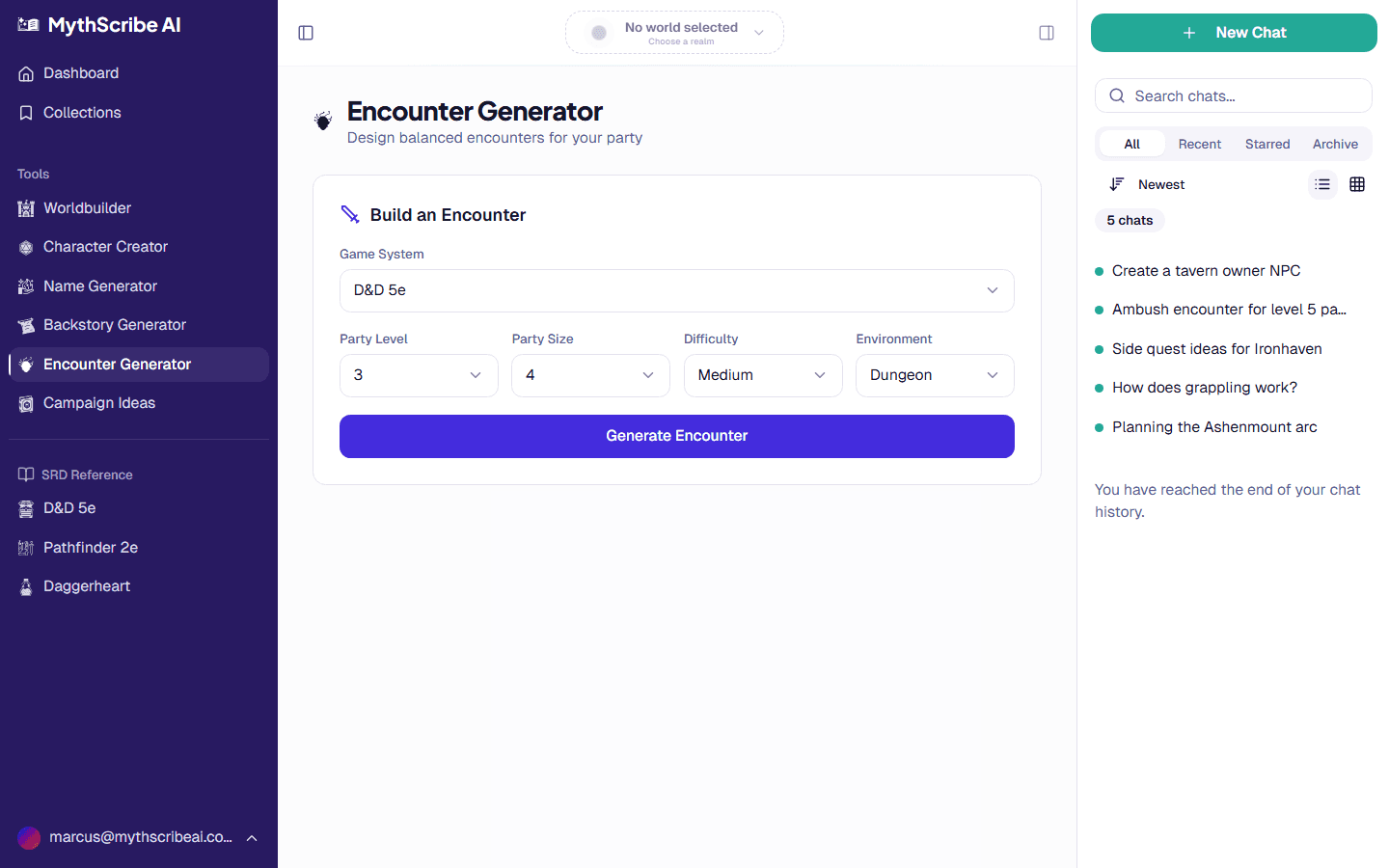 Encounter generator with party level and CR balancing
1. Forest: The Ambush That Isn't What It Seems
Setup: The party is traveling through dense forest when arrows begin flying from the treeline. But the attackers are bandits, not monsters — and they're clearly inexperienced and terrified.
What's actually happening: The "bandits" are starving villagers who've been raiding travelers to feed their community after a drought or occupation. The leader is a teenager trying to hold their group together.
Environment features:
- Partial cover from trees (half cover = +2 AC)
- Difficult terrain in the undergrowth (costs 2 feet of movement per foot)
- A clearing where the "bandits" are exposed if the party flanks
The decision: Fight (easy win, morally hollow), talk (requires good rolls and creativity), or let them go (and discover why they're desperate).
Escalation: If combat starts, a wounded bandit screams a child's name — and a seven-year-old runs into the clearing.
Level range: 1-6. Scale by adding more "bandits" or making the leader a higher-level fighter.
2. Dungeon: The Room That Watches
Setup: A room with no obvious exit, no visible monsters, and a single pedestal in the center holding a gem. Every surface is smooth stone. The gem pulses faintly.
What's actually happening: The room is the lair of an invisible stalker (or modified shadow demon at lower levels) that has been bound here for centuries to guard the gem. It attacks anyone who touches the gem — but it's also desperately lonely and will engage with anyone who speaks to it.
Environment features:
- Complete silence except for the party's movement
- The gem emits dim light (10 feet) in the otherwise dark room
- A pressure plate hidden under the pedestal triggers a stone ceiling that descends 1 inch per round if triggered
The decision: Take the gem (combat), leave it (the bound creature begs them to take it so it can finally rest), or find a way to free the creature from its binding.
Escalation: While the party deliberates, a second group of adventurers enters from a secret door they found.
3. Urban: The Crowd Panics
Setup: The party is in a crowded marketplace when screaming starts at the far end. A runaway cart, a fire, a mad ox, or a pickpocket chased by guards has sent hundreds of people running — directly toward the party.
Environment features:
- Difficult terrain for anyone in the crowd (DC 12 Strength or Dexterity save each round or fall prone)
- Stalls and carts provide half cover
- A child separated from their parent is crying 30 feet away, being trampled toward
- The actual threat (whatever caused the panic) is still happening at the far end
The decision: Help people escape (skill challenge), chase the threat, or protect the child first. They can't do all three.
Skill challenge: Each successful action (Athletics to move through the crowd, Persuasion to calm people, Perception to spot the source) earns progress toward preventing a disaster. Three failures before five successes = three NPCs are seriously injured.
Level range: 1-10. At higher levels, the "runaway cart" is replaced by a summoned creature, a fire elemental, or an assassin chased by guards.
4. Underwater: The Sunken Temple
Setup: The party dives into a lake or bay to investigate a sunken ruin. The structure is intact but partially flooded — some chambers have air pockets, others are fully submerged.
Environment features:
- Submerged areas require swimming (DC 10 Athletics or treat as difficult terrain)
- Characters without water breathing can hold their breath for CON score in rounds, then must make DC 10 CON saves each round or gain a level of exhaustion
- The ruins are unstable — a failed attack roll or a critical hit triggers a cave-in in that chamber (DEX save DC 13 or take 2d10 bludgeoning damage)
- Ranged weapons don't work underwater; melee attacks have disadvantage unless the attacker has a swimming speed
What's in there: A trapped water elemental who has been defending the temple from looters, and an ancient puzzle that releases it.
The decision: Fight through (costly and exhausting), solve the puzzle (requires ancient languages or high Arcana/History), or communicate with the elemental (it can't speak but responds to gestures).
5. Mountain/Arctic: The Failing Bridge
Setup: The only crossing over a deep ravine is a rope bridge that's been partially cut — sabotage. The party is halfway across when the first support rope snaps.
Environment features:
- The bridge can hold 3 tons — but each combat action (attack, grapple, forced movement) on the bridge snaps one support rope
- After 4 ropes snap, the bridge collapses (DEX save DC 15 to grab a rope, DC 20 to reach a ledge)
- High winds give disadvantage on ranged attacks
- Enemies on the far side who cut the bridge are shooting while the party crosses
The decision: Sprint for the far side (risk taking hits with no cover), fight back (risk snapping the bridge), or find a creative solution (anchor ropes, improvise).
Escalation: There's an NPC — a wounded guide — clinging to the bridge who can't move fast enough on their own.
6. Desert: The Oasis Isn't What It Seems
Setup: After two days without water, the party spots an oasis. The water is cool and clear. There's shade. There are no tracks.
What's actually happening: A group of yuan-ti (or harpies at lower levels) has been maintaining the oasis as a trap. The "water" is safe — but sleeping there is not.
Environment features:
- The oasis feels magically soothing (DC 12 Wisdom save or feel compelled to rest here for at least 4 hours)
- Characters who rest here must succeed on DC 14 Perception checks to notice the predators gathering
- A partially buried caravan in the sand 200 feet away shows signs of a previous "rest"
Daytime vs. nighttime: During the day, enemies hide underground (burrow speed). At night, they emerge silently and attack sleeping characters first.
The decision: Rest (risky but necessary given exhaustion levels), push on (possibly lethal without water), or investigate first.
7. Haunted/Gothic: The House Won't Let Them Leave
Setup: The party takes shelter from a storm in an abandoned manor. By midnight, the doors won't open. Candles snuff and relight on their own. And something is very upset that they're here.
Environment features:
- Dim light everywhere (disadvantage on Perception checks)
- Cold spots that deal 1d4 cold damage to characters who pass through without a DC 11 Constitution save
- Furniture moves on its own (difficult terrain, changes layout between rooms)
- Mirrors show the party's worst memories (DC 13 Wisdom save or be frightened for 1 minute)
What's happening: The house's original owner (a ghost) has unfinished business. The poltergeist activity escalates if ignored, calms if the party engages with it directly.
The goal: Discover what the ghost needs to move on. It's not a combat encounter — it's an investigation. But it becomes combat if the party attacks the ghost or fails a climactic skill challenge.
8. Underdark: Light Is the Resource
Setup: Deep in the underdark, a chamber where the party must cross a 300-foot fungal plain to reach the exit. The fungi are bioluminescent — but anything that emits light above a candle's glow attracts the blind predators in the ceiling.
Environment features:
- Normal light sources (torches, light cantrip, dancing lights) immediately trigger 1d4 blindheim or grell attacking from above
- Darkvision works fine — but spellcasters who rely on seeing targets suffer disadvantage on ranged spells
- The ground is soft and silent; Stealth checks have advantage
- Phosphorescent patches (dimly lit, safe) form a dotted path across — the party can follow them in single file without drawing attention
The challenge: Navigate the crossing while managing spell use, light sources, and a player who forgot they were wearing Boots of Elvenkind (they glow).
Escalation: One creature is already following them from 60 feet behind, just out of darkvision range.
9. Planar: The Rules Are Different Here
Setup: A planar rift drops the party into Mechanus (or a custom clockwork plane). The laws of physics work differently. Gravity shifts 90 degrees every hour. Every spoken lie causes pain (DC 10 CON save or take 1d4 psychic damage). The inhabitants are modrons — constructs following incomprehensible instructions.
Environment features:
- Gravity shift: when it happens, everyone makes a DC 12 Dexterity save or falls "sideways" 20 feet
- Lying hurts — this includes bluffing, persuasion that involves false claims, and deception checks
- Modrons won't attack unless the party violates their programmed directive (which is unclear)
The goal: Find the rift home before it closes. The modrons know where it is — if the party can communicate with them, which requires either Comprehend Languages or correctly guessing the logic the modrons use to classify the party.
The decision: Solve it as a puzzle (no combat), fight through (the modrons are everywhere), or find the one modron that's been corrupted and will actually talk.
10. City Siege: The Walls Are Falling
Setup: The party is inside a city under attack. The main gate has been breached. The city guard is overwhelmed. Three things are happening simultaneously and only the party can help.
The three crises:
- The gate — enemies are pouring in; someone has to hold them long enough for a portcullis to be lowered (Strength skill challenge against 5 rounds of enemies)
- The wizard's tower — the court wizard is trying to cast a ward but needs 3 minutes of uninterrupted concentration; enemies are 90 seconds away
- The evacuation — the city's children are being moved to the keep but the route is blocked by a collapsed building (Athletics/Investigation to clear it)
The decision: Split the party (each crisis takes 1-2 characters), prioritize, or find a faster creative solution to one crisis that frees up people for the others.
Why this works: Everyone has something to do, the stakes are clear, and failure at any crisis has immediate visible consequences that the party has to live with.
Making These Yours
A few principles that elevate any encounter:
The environment is a character. Don't just describe the room — describe what the room does when things go wrong. Rope bridges break. Fire spreads. Crowds run.
Give enemies a goal other than "kill the party." Bandits want to escape with loot. A cornered animal wants to run. Even undead can be pursuing something (completing their unfinished business) rather than just attacking.
Let the party be clever. If the encounter has one obvious solution, it's a set piece. If there are three obvious solutions and the party invents a fourth, it's a story they'll tell for years.
Use the MythScribe Encounter Generator to get CR-balanced stat blocks, XP budgets, and tactical notes for any of these setups — customized by party size, level, and game system.
Try These Tools Free
Put what you just read into practice.