Pathfinder 2e is one of the most mechanically rich tabletop RPGs ever published. It's also one of the most complex to build a character in. Between ancestries, heritages, backgrounds, classes, four types of feats (ancestry, class, general, skill), proficiency ranks, and the three-action economy — a first Pathfinder 2e character can take hours to build from scratch.
This guide covers how PF2e character creation works, what every choice means, and how AI can handle the mechanical work so you can focus on the creative part.
How Pathfinder 2e Character Creation Works
PF2e character creation follows a structured sequence. At first level, you make choices in this order:
- Create a concept — The narrative idea for who this character is
- Choose an ancestry — Your species, which grants ability boosts, Hit Points, size, speed, and an ancestry feat
- Choose a background — Your character's pre-adventuring life, which grants two ability boosts, a skill proficiency, and a skill feat
- Choose a class — Your primary mechanical identity, determining your role in combat and the types of abilities you gain
- Determine ability scores — PF2e uses "ability boosts" instead of a single array; you apply boosts from your ancestry, background, class, and four free boosts
- Record class features — Your class grants proficiencies, special features, and your first class feat at level 1
- Buy equipment — You start with gold based on your class and spend it on weapons, armor, and supplies
- Finalize details — Name, alignment, deity, personality, and backstory
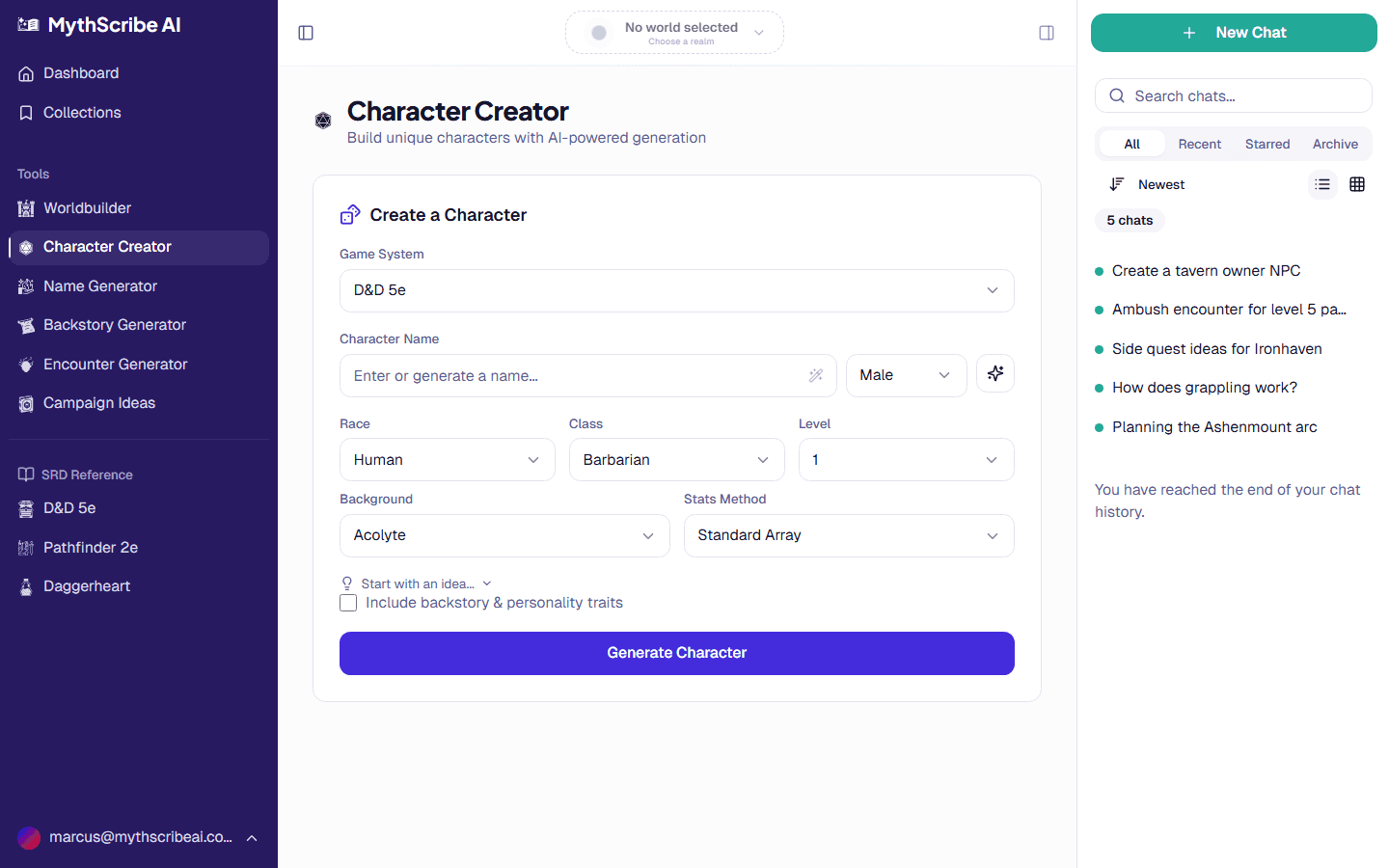 AI character creator supporting Pathfinder 2e with ancestry and class selection
PF2e Ability Scores: Boosts, Not Arrays
One of the biggest differences between PF2e and D&D 5e is how ability scores work. Instead of a standard array or rolling dice, PF2e uses ability boosts:
- Each boost raises an ability score by 2 (or by 1 if the score is already 18+)
- At level 1, you gain boosts from your ancestry (usually two fixed + one free), your background (two to specific abilities), your class (one to the key ability), and four additional free boosts
- Abilities start at 10, so most level 1 characters end up with key ability scores of 16–18
This system makes it nearly impossible to accidentally build a mechanically useless character — but tracking the boost cascade manually is tedious. AI character creators handle this automatically.
Pathfinder 2e Ancestries
PF2e has 40+ ancestries available across official sourcebooks. Common choices from the core book and free SRD:
- Human — One free ancestry feat, one free ability boost, extra skill training
- Elf — Long-lived, +2 Dex and Int, low-light vision, Elven heritage choices
- Dwarf — Hardy and sturdy, +2 Con and Wis, Darkvision, clan dagger starting weapon
- Gnome — Small, +2 Con and Cha, low-light vision, colorful gnome heritages
- Halfling — Small and lucky, +2 Dex and Wis, keen halfling senses
- Goblin — Chaotic and quick, +2 Dex and Cha, Darkvision, goblin heritages
- Leshy — Plant-based beings, +2 Con and Wis, natural camouflage
- Orc — Powerful and fierce, +2 Str, low-light vision, orc ferocity
Each ancestry also has heritages — sub-ancestries that modify the baseline. An Elf might be a Cavern Elf (Darkvision) or an Ancient Elf (extra multiclass training). This adds another layer of customization that AI handles without additional effort.
Pathfinder 2e Classes
PF2e has 22 classes in the core and expanded books. Key classes from the core rulebook:
| Class | Key Ability | Role |
|---|---|---|
| Alchemist | Intelligence | Bombs, elixirs, mutagens |
| Barbarian | Strength | Rage-fueled melee powerhouse |
| Bard | Charisma | Support spellcaster and skill specialist |
| Champion | Strength or Dexterity | Divine defender with reactive abilities |
| Cleric | Wisdom | Divine spellcaster; healer or blaster depending on doctrine |
| Druid | Wisdom | Nature spellcaster; can shapeshift or summon animals |
| Fighter | Strength or Dexterity | Best weapon attacks in the game |
| Monk | Strength or Dexterity | Unarmed martial artist with ki powers |
| Ranger | Strength or Dexterity | Versatile hunter; can use a companion |
| Rogue | Dexterity | Sneak attacker with massive skill versatility |
| Sorcerer | Charisma | Bloodline-driven spontaneous spellcaster |
| Wizard | Intelligence | Prepared arcane spellcaster with enormous spell list |
The Four Types of Feats in PF2e
The feat system is the most distinctive — and most complex — part of PF2e character building. You choose feats from four pools at different levels:
- Ancestry feats — Gained at levels 1, 5, 9, 13, 17. Come from your ancestry or heritage options. Provide racial abilities, physical traits, or special senses.
- Class feats — Gained at level 2 and every even level. The core of your character's combat and class identity. Each class has 10–30 class feats to choose from.
- Skill feats — Gained at level 2 and every even level. Tied to skills; provide special ways to use trained or higher skills.
- General feats — Gained at levels 3, 7, 11, 15, 19. Broad utility feats: Toughness, Incredible Initiative, Fleet, etc.
A level 5 PF2e character has already made 8+ feat choices. A level 10 character has made 20+. AI character creators collapse this decision tree into a single generation.
Pathfinder 2e Character Sheet
The official PF2e character sheet has more sections than a D&D 5e sheet. Key differences:
- Proficiency ranks — Untrained (−4), Trained (+level), Expert (+level+1), Master (+level+2), Legendary (+level+3) instead of flat proficiency bonus
- Action types — Actions (single), Reactions, Free Actions. Most abilities have specific action costs.
- Conditions section — PF2e has 40+ conditions (Drained, Enfeebled, Frightened, etc.) with numerical ratings
- Resonance/Focus Pool — For spellcasters who use Focus Points
- Ancestral features — A dedicated section for heritage features separate from class features
The official PF2e character sheet is free at Paizo.com. The Archives of Nethys (aonprd.com) is the authoritative free rules reference for all PF2e content.
Why Use an AI Pathfinder 2e Character Creator?
Manual PF2e character creation has three major pain points:
1. The ability boost cascade. Tracking which boosts came from ancestry, background, class, and free choices — and applying them in the right order — is error-prone. AI handles this automatically.
2. Feat selection paralysis. With 10+ feat options at every even level, new players often spend more time reading feat descriptions than playing. AI makes reasonable choices for the concept you give it, which you can then refine.
3. Derived stat calculations. AC calculation in PF2e (proficiency rank + level + Dexterity modifier, up to armor cap) is more involved than D&D's simple formula. Skill modifiers, attack bonuses, save bonuses — all involve the same proficiency-rank-plus-level formula. AI handles all of this.
MythScribe's character creator supports Pathfinder 2e natively. When you select PF2e, you get:
- PF2e-accurate ability boosts (not D&D ability scores)
- Correct PF2e terminology: ancestries (not races), heritages (not subraces)
- Three-action-economy-aware descriptions
- Level-appropriate feat choices from each of the four pools
- PF2e-correct proficiency bonuses (+level modifier, not flat +2 to +6)
PF2e Character Creation Step by Step (AI-Assisted)
Here's what the flow looks like with MythScribe:
- Select Pathfinder 2e as your game system
- Type a concept (optional) — "a goblin alchemist who uses bombs to fix problems, not people"
- Click Generate — The AI fills in ancestry, heritage, background, class, ability scores, feats, equipment, and backstory
- Review and refine — Regenerate the backstory, swap the name, adjust the feat choices
- Save to your world — If you're using the Worldbuilder, the character is saved to your campaign for AI reference
Pathfinder 2e vs D&D 5e: Which Should You Play?
Both are excellent games. Here's the honest comparison:
| Pathfinder 2e | D&D 5e | |
|---|---|---|
| Character complexity | High — more choices, more depth | Medium — streamlined |
| Combat depth | Very high — three actions, many options | Moderate |
| Free official content | Extensive (Archives of Nethys) | Limited SRD only |
| Community size | Large and growing | Massive |
| New player friendliness | Steeper curve | More approachable |
| AI tool support | MythScribe | MythScribe + D&D Beyond |
PF2e rewards players who enjoy optimization and deep mechanical engagement. D&D 5e rewards players who want faster, more flexible gameplay with less rules lookup. Many experienced players play both.
Frequently Asked Questions
Is Pathfinder 2e free?
The core rules for Pathfinder 2e are available for free via the Archives of Nethys (aonprd.com), which includes all released content. The physical core rulebook and expansion books are sold separately. There is no subscription required to access the rules.
How long does Pathfinder 2e character creation take?
Manual character creation for a first-time PF2e player typically takes 2–4 hours. Experienced players can build a character in 30–60 minutes. With AI assistance, a complete PF2e character can be generated in under a minute — though you'll likely want to spend 5–10 minutes reviewing and personalizing the output.
What is a Pathfinder 2e character sheet?
A PF2e character sheet records your character's ability scores, proficiency ranks, skills, feats, equipment, and features. The official free sheet is available at Paizo.com. Key differences from D&D 5e sheets: proficiency ranks instead of a flat bonus, a separate section for ancestry and heritage features, and action economy notation.
Can I play Pathfinder 2e without buying any books?
Yes. The Archives of Nethys (aonprd.com) contains the complete rules for free, including all ancestries, classes, feats, spells, and monsters from official published content. You can play an entire campaign using only free online resources.
What is the best class for a new Pathfinder 2e player?
Fighter is consistently recommended for new players. It has excellent action economy, straightforward gameplay, and the best attack bonuses in the game. The Champion (paladin-type) is also beginner-friendly, with reactive abilities that are easy to understand. Avoid Alchemist and Summoner for your first character — both have complex systems that take time to learn.
Try These Tools Free
Put what you just read into practice.