Daggerheart is the fantasy RPG from Darrington Press — the studio behind Critical Role — and it has rapidly become one of the most-played new systems since its 2025 release. If you're picking it up for the first time, the Daggerheart character sheet is the first thing you need to understand. It looks different from a D&D sheet, the terminology is different, and the mechanics it tracks are fundamentally different. This guide walks through every section of the sheet, explains the rules behind each field, and shows you how to fill it out step by step.
What Is Daggerheart?
Daggerheart is a narrative-driven fantasy TTRPG designed by Spenser Starke and Rowan Hall. It uses a dual d12 system called Duality Dice — one Hope die and one Fear die — instead of the single d20 that most players are used to. When you roll, you add both dice together plus a trait modifier and compare the total to a Difficulty number. But which die rolls higher matters just as much as whether you succeed:
- Hope die higher: You succeed and gain a Hope token (a spendable resource).
- Fear die higher: You succeed, but the GM gains a Fear token (fuel for complications and escalations).
- Doubles: Critical success — automatic success with a bonus, plus you gain Hope and clear Stress.
- Failure: The spotlight shifts to the GM, who makes a move. Whether you failed with Hope or Fear determines the severity.
This creates a rhythm that D&D doesn't have. Every roll shifts the economy of the table. A string of Fear-heavy rolls floods the GM with resources to escalate danger. A hot streak of Hope rolls empowers the players. The result is sessions with natural dramatic arcs built into the dice.
Daggerheart supports 2-5 players plus a GM, with sessions running 2-4 hours. The full SRD is available for free, so you can start without buying the core rulebook.
The Daggerheart Character Sheet Explained
The Daggerheart character sheet tracks fundamentally different things than a D&D sheet. There are no ability scores from 1-20, no Armor Class, no spell slots. Here's what each section contains and why it matters.
Traits
Daggerheart characters have six traits — not ability scores, traits. Each one gets a modifier (typically ranging from -1 to +2 at character creation), and when you "roll with a trait," you add that modifier to your Duality Dice total.
| Trait | What It Covers |
|---|---|
| Agility | Sprinting, leaping, maneuvering, reacting to danger |
| Strength | Lifting, smashing, grappling, feats of physical power |
| Finesse | Stealth, precision, tinkering, fine control |
| Instinct | Perception, sensing danger, navigation, tracking |
| Presence | Charming, performing, deceiving, social influence |
| Knowledge | Recalling facts, analyzing, comprehension, deduction |
At character creation, you distribute the array +2, +1, +1, +0, +0, -1 across your six traits. There's no rolling for stats, no point buy — everyone gets the same spread, and you place them to fit your class and character concept.
If you're coming from D&D, the biggest shift is the absence of Constitution. There's no hit point modifier tied to a single trait. Your starting HP is determined entirely by your class, and Stress (the second health pool) starts at 6 for everyone.
Ancestry and Community
Daggerheart splits the concept of "race" into two distinct choices: ancestry and community. Together, they form your character's heritage.
Ancestry reflects your character's lineage and physical traits. There are 18 ancestries in the core rules, each granting two ancestry features. The list goes well beyond standard fantasy fare:
- Clank — sentient mechanical beings, effectively immortal as long as they can find replacement parts
- Drakona — dragon-descended humanoids
- Galapa — turtle-folk with natural resilience
- Ribbet — frog-people known for agility
- Katari — feline humanoids
- Fungril — mushroom-like beings
- Simiah — ape-folk
- Plus traditional ancestries: Dwarf, Elf, Faerie, Faun, Firbolg, Giant, Goblin, Halfling, Human, Infernis, Orc
You can also create a Mixed Ancestry by taking the first feature from one ancestry and the second from another — a simple, flexible system.
Community represents the culture or environment that shaped your character's upbringing. There are 9 communities, each granting a community feature and personality-shaping adjectives:
Highborne, Loreborne, Orderborne, Ridgeborne, Seaborne, Slyborne, Underborne, Wanderborne, Wildborne
For example, a Highborne character gains the Privilege feature — advantage on rolls to consort with nobles, negotiate prices, or leverage reputation. A Ridgeborne character would have different strengths tied to mountain life and rugged self-reliance.
Class and Subclass
Daggerheart has 9 classes, and each one is tied to two of the game's 9 domains. Domains are themed card decks that provide your abilities, spells, and special features as you level up.
| Class | Domains | Role |
|---|---|---|
| Bard | Grace, Codex | Social support, rallying allies, performance |
| Druid | Sage, Arcana | Shapeshifting, nature magic, wilderness mastery |
| Guardian | Blade, Valor | Frontline tank, damage mitigation, protection |
| Ranger | Bone, Sage | Ranged combat, tracking, animal companions |
| Rogue | Midnight, Grace | Stealth, precision damage, deception |
| Seraph | Splendor, Valor | Divine combat, healing, sacred purpose |
| Sorcerer | Arcana, Midnight | Innate magic, chaos, raw power |
| Warrior | Blade, Bone | Weapon mastery, opportunity attacks, martial skill |
| Wizard | Codex, Splendor | Learned magic, prestidigitation, pattern-reading |
Unlike D&D, you choose your subclass at character creation — not at level 2 or 3. Each class has exactly two subclass options, and your choice immediately grants a Foundation feature, a Spellcast trait, and a path toward Specialization and Mastery features at higher levels. This means two players picking the same class can feel meaningfully different from session one.
Each class also has a Hope Feature that costs 3 Hope to activate (such as the Guardian's Frontline Tank, which clears armor slots) and one or more Class Features that define the class's core identity (like the Warrior's Attack of Opportunity or the Druid's Beastform).
Damage Thresholds
This is the biggest mechanical departure from D&D's hit point system. In Daggerheart, when you take damage, you don't subtract the number from a pool. Instead, your armor has two damage thresholds — a Major threshold and a Severe threshold — and the amount of damage determines how many HP you mark:
- Below Major threshold: Mark 1 HP
- At or above Major, below Severe: Mark 2 HP
- At or above Severe: Mark 3 HP
- Reduced to 0 or less: No HP marked
Your thresholds are calculated by adding your character level to your equipped armor's base thresholds. For example, Chainmail Armor has base thresholds of 7/15. At level 1, your thresholds become 8 (Major) and 16 (Severe).
Your Armor Score represents how many hits your armor can absorb before it's depleted — tracked by marking armor slots. Once your armor slots are spent, damage hits your HP directly.
Characters also have Evasion — a static number that attackers must meet or beat to hit you. It functions similarly to AC in D&D but is set by your class and modified by armor features, not calculated from Dexterity.
Starting HP varies by class (5-7 at level 1), and every character gets 6 Stress slots. Stress is a second health pool consumed by magical, emotional, and mental strain. When either HP or Stress reaches zero, you're in serious trouble.
Hope and Fear Tokens
Hope and Fear are the central economy of Daggerheart and one of its most distinctive features.
Hope is a player-facing resource. You gain it when your Hope die rolls higher on an action roll, and you can spend it to:
- Activate your class Hope Feature (costs 3 Hope)
- Add an Experience modifier to a roll
- Use certain domain card abilities
- Aid allies through various mechanics
Fear is a GM-facing resource. The GM gains Fear when the Fear die rolls higher, and spends it to:
- Make GM moves (environmental hazards, enemy actions, narrative complications)
- Escalate encounters
- Trigger adversary abilities
All players start each session with 2 Hope. There is no equivalent to this system in D&D — Inspiration is the closest comparison, but it's a single-use token given at GM discretion rather than a constantly fluctuating economy that shapes the entire session.
Equipment and Gold
Daggerheart handles equipment and wealth differently than most fantasy RPGs.
Weapons come in two configurations: a single two-handed primary weapon, or a one-handed primary weapon paired with a one-handed secondary weapon. At level 1, your Proficiency is 1, which determines how many damage dice you roll. Your damage roll combines your Proficiency with your weapon's damage dice.
Armor provides your damage thresholds, armor score (damage absorption slots), and potentially an Evasion modifier. Tier 1 armor options include Gambeson (light, flexible, +1 Evasion), Leather, Chainmail (heavy, -1 Evasion), and Full Plate.
Gold is tracked abstractly in three denominations: handfuls, bags, and chests. Ten handfuls equal 1 bag; 10 bags equal 1 chest. Characters start with a handful of gold. There's no copper-silver-gold-platinum spreadsheet — just mark boxes on your sheet.
Every character also starts with a torch, 50 feet of rope, basic supplies, a potion (Health or Stamina), and a class-specific item.
How to Create a Daggerheart Character Step by Step
The official character creation process follows 9 steps. Here's the condensed version:
-
Choose your class and subclass. Pick from the 9 classes, then select one of the two available subclasses. Take your class's character sheet and character guide printouts.
-
Choose your ancestry. Select from 18 ancestries (or create a Mixed Ancestry). Record both ancestry features.
-
Choose your community. Select from 9 communities. Record your community feature.
-
Assign traits. Distribute +2, +1, +1, +0, +0, -1 across Agility, Strength, Finesse, Instinct, Presence, and Knowledge. Your class's suggested array is a good starting point.
-
Record base stats. Copy your starting Evasion and HP from your class, mark 6 Stress slots, and set Hope to 2.
-
Choose equipment. Select weapons from the Tier 1 table, pick armor, and record your damage thresholds (armor base thresholds + level). Take your starting inventory items.
-
Create your background. Answer the background questions in your character guide to establish who your character was before adventuring.
-
Create Experiences. Choose two Experiences (words or phrases like "Bounty Hunter," "Silver Tongue," or "Hold the Line") at +2 each. These can be spent with Hope to boost relevant rolls.
-
Choose domain cards. Pick two level 1 cards from your class's two domains to form your starting loadout.
There's also a step 10 at the table: create Connections between your character and the other PCs using guided questions.
The whole process takes 30-45 minutes for a new player with the book in hand. If you want to skip the manual work, read on.
AI Daggerheart Character Creator
MythScribe's Daggerheart Character Creator handles the entire Daggerheart character sheet for you. Tell it a concept — or let it surprise you — and it generates a complete character with ancestry, community, class, subclass, traits, equipment, Experiences, domain cards, and a backstory that ties everything together.
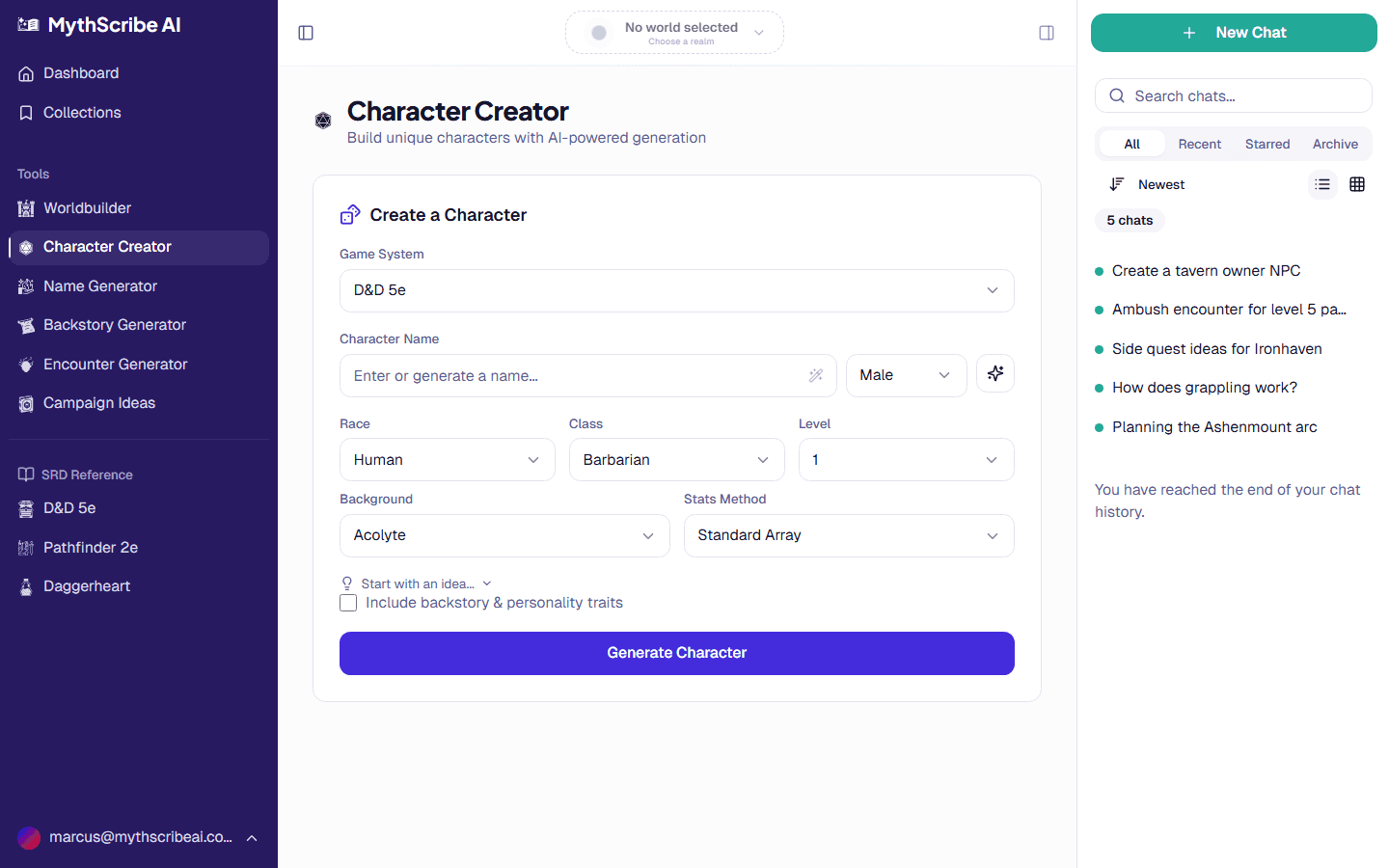 Daggerheart character creator with AI-generated traits and backstory
The generator pulls from the official SRD data, so your character's mechanics are rules-accurate. It assigns traits to match your class, selects appropriate weapons and armor, calculates your damage thresholds, and writes a backstory that connects your ancestry, community, and Experiences into a coherent narrative. You can edit any field after generation — it's a starting point, not a straitjacket.
This is particularly useful for Daggerheart because the system has so many interlocking choices (ancestry features, community features, class features, subclass features, domain cards, Experiences) that can overwhelm a player coming from D&D. The AI handles the interactions so you can focus on playing.
If you're building for D&D 5e instead, MythScribe has a dedicated generator for that system too.
Daggerheart vs D&D Character Sheets
If you're coming from D&D, here's how the two sheets compare:
| Concept | D&D 5e | Daggerheart |
|---|---|---|
| Core stats | 6 ability scores (3-20, modifiers -1 to +5) | 6 traits (modifiers -1 to +2 at creation) |
| Dice mechanic | 1d20 + modifier vs DC | 2d12 (Hope + Fear) + modifier vs Difficulty |
| Survivability | AC + HP pool (subtracted per hit) | Evasion + Armor Slots + HP (1-3 marked per hit based on damage thresholds) |
| Mental/magical resilience | Saving throws, HP | Stress (separate 6-slot pool) |
| Heritage | Race (1 choice) | Ancestry + Community (2 choices) |
| Subclass timing | Level 2-3 | Level 1 |
| Abilities/spells | Spell slots, class features | Domain cards (loadout of 5, swappable) |
| Currency | Copper / Silver / Gold / Platinum | Handfuls / Bags / Chests |
| Death | Death saving throws (3 successes or failures) | Death moves (narrative, player-driven) |
| Session resource | Inspiration (single token, DM-given) | Hope/Fear economy (constantly shifting) |
| Skills | 18 skills with proficiency | Experiences (custom, player-defined) |
The key philosophical difference: D&D character sheets are built around math optimization (maximizing modifiers, AC, damage output). Daggerheart character sheets are built around narrative identity — your Experiences, background questions, and Connections are given equal weight to your combat stats.
For a deeper mechanical comparison, see our full Daggerheart vs D&D breakdown.
Frequently Asked Questions
Is there a free Daggerheart character sheet? Yes. The Daggerheart SRD is free and includes printable character sheets for all 9 classes. You can also use the MythScribe Daggerheart Character Creator to generate a complete, filled-out character sheet for free online.
Can I use MythScribe for Daggerheart? Yes. MythScribe supports Daggerheart across all its generators — character creation, backstory generation, encounter building, and campaign planning. All generators pull from the official SRD data for accurate mechanics.
What dice do you need for Daggerheart? You need two twelve-sided dice (d12s) in different colors — one for Hope, one for Fear. These are your Duality Dice, used for every action roll. You'll also occasionally need d4s, d6s, d8s, d10s, and d20s for damage rolls, class features, and certain abilities, but the d12 pair is the core of the system.
How many players can play Daggerheart? Daggerheart is designed for 1 GM and 2-5 players. The spotlight system (which replaces traditional initiative) works best with 3-4 players, but the game scales comfortably across its full range.
Do I need the core rulebook to play? No. The SRD contains all the mechanical rules, classes, ancestries, communities, domain cards, and equipment you need to play. The core rulebook adds setting lore, artwork, expanded examples, and GM advice — but it's not required.
Can I convert my D&D character to Daggerheart? Not directly — the systems are too mechanically different for a 1:1 conversion. But you can recreate the concept. A D&D Paladin maps well to a Daggerheart Seraph. A D&D Rogue translates naturally to the Daggerheart Rogue. Use your D&D character's personality and backstory as a starting point and rebuild the mechanics from scratch using Daggerheart's system.
Try These Tools Free
Put what you just read into practice.