Loot is one of the most satisfying parts of D&D. A well-placed magic item can define a character for an entire campaign. A strange artifact can launch a quest arc nobody saw coming. But there's a gap between rolling on a generic table and actually creating treasure that feels like it belongs in your world. A good D&D loot generator bridges that gap — it gives you treasure that fits the encounter, the enemy, and the story you're telling.
This guide covers how 5e loot tables work, how to build your own, and how AI tools can generate contextual treasure that goes beyond "you find 2d6 gold pieces."
What Is a D&D Loot Generator?
A D&D loot generator is any tool that creates treasure drops based on parameters like challenge rating, party level, dungeon type, or enemy faction. At their simplest, these are digital versions of the DMG treasure tables — you input a CR, and the generator rolls for gold, gems, art objects, and magic items. At their best, they produce loot that tells a story: a bandit captain carrying a letter sealed with noble wax, a dragon's hoard that includes the crown of a kingdom it destroyed decades ago.
Most generators fall into two categories:
- Table-based generators that replicate the DMG's random treasure tables with automated dice rolls
- AI-powered generators that create contextual, narrative-driven loot based on the specific encounter
Both have their place. Table-based generators are fast and consistent. AI generators are better when you want treasure that connects to the broader campaign.
How D&D 5e Loot Tables Work
The Dungeon Master's Guide provides two systems for treasure: individual treasure (what a single creature is carrying) and hoard treasure (the accumulated wealth of a lair or boss). Understanding both is essential before you start customizing.
Individual Treasure
Individual treasure represents what a single monster has on its person — coins in a pouch, a gemstone in a pocket, a stolen trinket. The DMG provides four tables based on CR range. You roll a d100 and cross-reference the result.
This is the loot you hand out after a random encounter on the road or a fight with a patrol. It's not meant to be exciting — it's meant to keep the economy ticking. Most individual treasure is copper, silver, and gold in small quantities.
Hoard Treasure
Hoard treasure is the big payoff. This is the dragon's vault, the lich's treasury, the bandit lord's hidden stash. Hoard tables include guaranteed gold plus rolls on magic item tables. The DMG hoard tables are tiered by CR and scale dramatically.
Here's a simplified breakdown of what each tier looks like:
| CR Range | Coins (avg) | Gems/Art | Magic Items |
|---|---|---|---|
| CR 0-4 | 350 gp | 2d6 10gp gems or 2d4 25gp art | 1d6 rolls on Magic Item Table A or B |
| CR 5-10 | 2,300 gp | 2d4 25gp art or 3d6 50gp gems | 1d6 rolls on Table C, D, or F |
| CR 11-16 | 14,000 gp | 2d4 250gp art or 3d6 500gp gems | 1d4 rolls on Table D, E, G, or H |
| CR 17+ | 56,000 gp | 3d6 1000gp gems or 2d4 2500gp art | 1d6 rolls on Table E, G, H, or I |
The jump between tiers is steep by design. A CR 17+ hoard can include legendary items and tens of thousands of gold. A CR 0-4 hoard might contain a single uncommon magic item and a handful of gemstones.
The problem with these tables is that they're random without being interesting. You get "a 50gp garnet" — but where did it come from? Who mined it? Why does this goblin have it? That's where custom tables and AI generation come in.
Beyond Random Tables: AI Loot Generation
The biggest limitation of static loot tables is context. A bandit and a vampire shouldn't drop the same categories of treasure, even at the same CR. A dragon that razed an elven city should have elven relics in its hoard, not generic "art objects worth 250 gp." This is where AI-powered generation changes the game.
An AI D&D loot generator can take your encounter context — the enemy type, the setting, the party's level, and the narrative situation — and produce treasure that fits. Instead of "Potion of Healing," you get "a cracked glass vial wrapped in bloodstained linen, containing a viscous red liquid that smells faintly of iron — a battlefield medic's last potion, never used." Same mechanical effect, completely different story.
AI loot generation is especially useful for:
- Boss hoards where you want every item to feel intentional
- Cursed items with specific drawbacks tied to the item's history
- Quest hooks embedded in treasure (a map fragment, a coded letter, a locket with a portrait)
- Faction-specific gear that signals who the enemy worked for
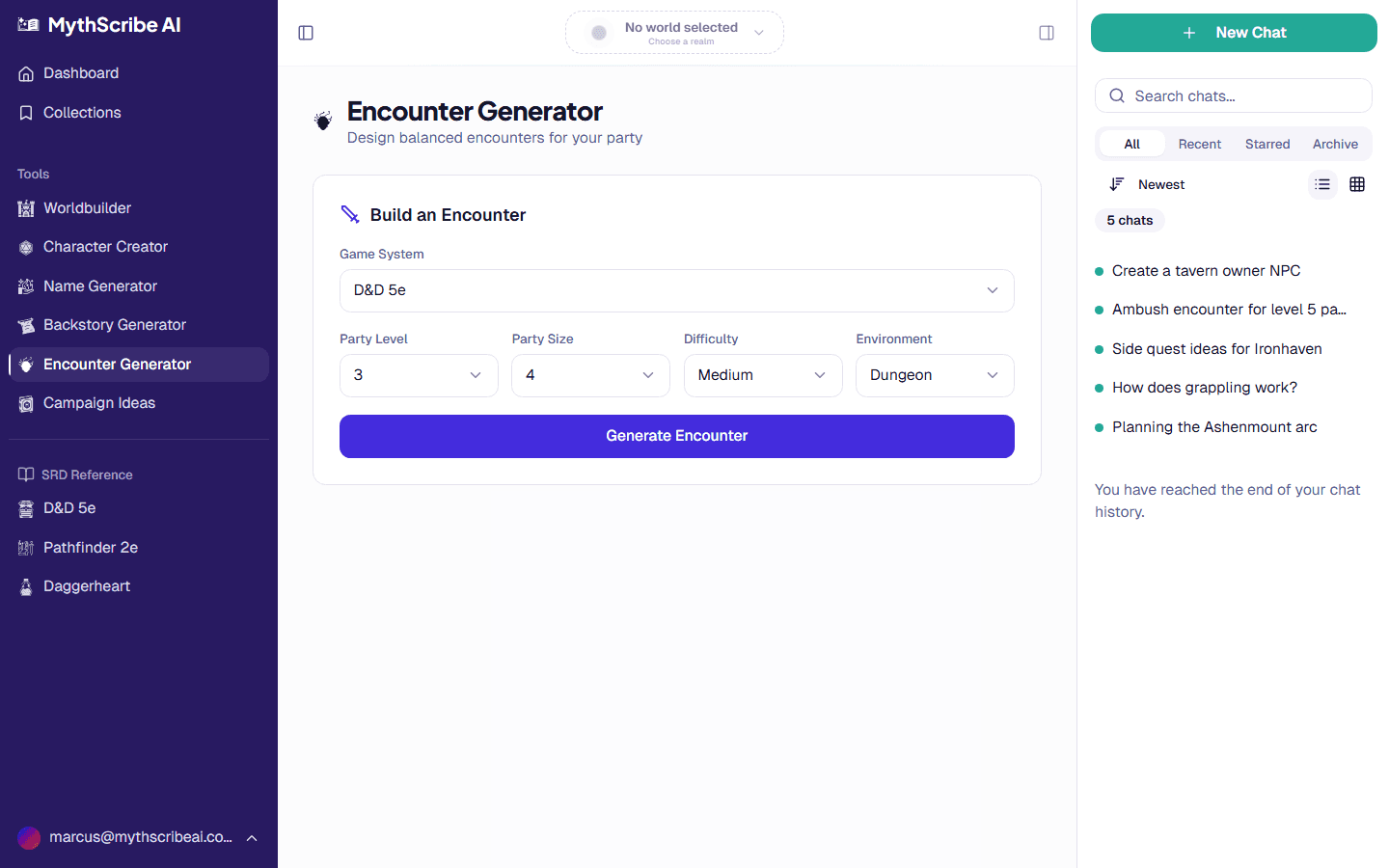 Encounter generator for balanced combat with loot context
Use the MythScribe Encounter Generator to build CR-balanced encounters, then feed the context into the AI Chat to generate loot that fits the enemies and environment you've set up. Ask it for a specific number of items, a rarity range, or treasure with built-in plot hooks.
How to Build Custom Loot Tables
If you prefer rolling on tables at the table (and many DMs do — there's a reason dice are satisfying), building your own loot tables gives you control without requiring improvisation in the moment. The key is making tables that are specific to the dungeon or region, not generic.
The Dice Table Approach
A d20 table is the sweet spot for most custom loot tables. It's big enough to have variety, small enough to fill without straining. Here's an example for a bandit hideout:
| d20 | Loot |
|---|---|
| 1 | A dented copper locket with a painted portrait inside (worthless but sentimental) |
| 2 | 2d6 silver pieces in a leather pouch |
| 3 | A crumpled wanted poster for one of the party members (or an NPC they know) |
| 4 | A half-empty bottle of expensive wine (worth 5 gp to the right buyer) |
| 5 | A steel dagger with a merchant guild's mark on the pommel |
| 6 | 3d6 gold pieces sewn into a coat lining |
| 7 | A set of loaded dice |
| 8 | A letter of safe passage signed by a minor noble |
| 9 | A healer's kit with 3 uses remaining |
| 10 | A crude map showing a nearby cave marked with an X |
| 11 | A pouch of caltrops (bag of 20) |
| 12 | A silver ring engraved with a name the party doesn't recognize (worth 10 gp) |
| 13 | 4d6 gold pieces |
| 14 | A small journal in a language the finder doesn't speak |
| 15 | A vial of antitoxin |
| 16 | A masterwork hand crossbow (non-magical but well-maintained) |
| 17 | A key on a chain — unlocks something elsewhere in the hideout |
| 18 | A Potion of Healing |
| 19 | A signet ring belonging to a missing noble (worth 25 gp, or worth a favor if returned) |
| 20 | A +1 dagger wrapped in oilcloth, clearly stolen from someone important |
Notice the structure: low rolls give flavor and small coin, mid rolls give useful mundane items, and high rolls give the real prizes. About half the entries have narrative hooks built in — the wanted poster, the journal, the noble's signet ring. That's what separates a custom table from the DMG defaults.
The Tiered Approach
For larger dungeons, build three tables instead of one:
- Mundane (minions/guards): Mostly coins, personal effects, and consumables. Roll on this for every minor enemy.
- Uncommon (lieutenants/elites): Better gear, magic consumables, and items that hint at the boss's plans. Roll on this for mini-bosses or named enemies.
- Rare (boss hoard): Magic items, large gold quantities, and at least one item with a story. This is the payoff table — you only roll on it once per dungeon.
This tiered system keeps treasure feeling earned. Players shouldn't find a +1 sword on every goblin. But they should find enough interesting mundane loot to stay engaged between the big drops.
Tracking Magic Items in Your World
Once you start handing out magic items regularly, tracking becomes a real problem. Who has the Cloak of Elvenkind? Where did the party stash those extra Potions of Greater Healing? What was the name of that cursed sword they sold to the merchant in Waterdeep three sessions ago?
A worldbuilder solves this. Instead of keeping a separate spreadsheet, you track magic items alongside the locations, NPCs, and factions they're connected to. When you log an item in a worldbuilder, you can tag it with rarity, current owner, origin, and any plot relevance — so when a player asks "wait, didn't we find a map in that bandit's stuff?" you have the answer.
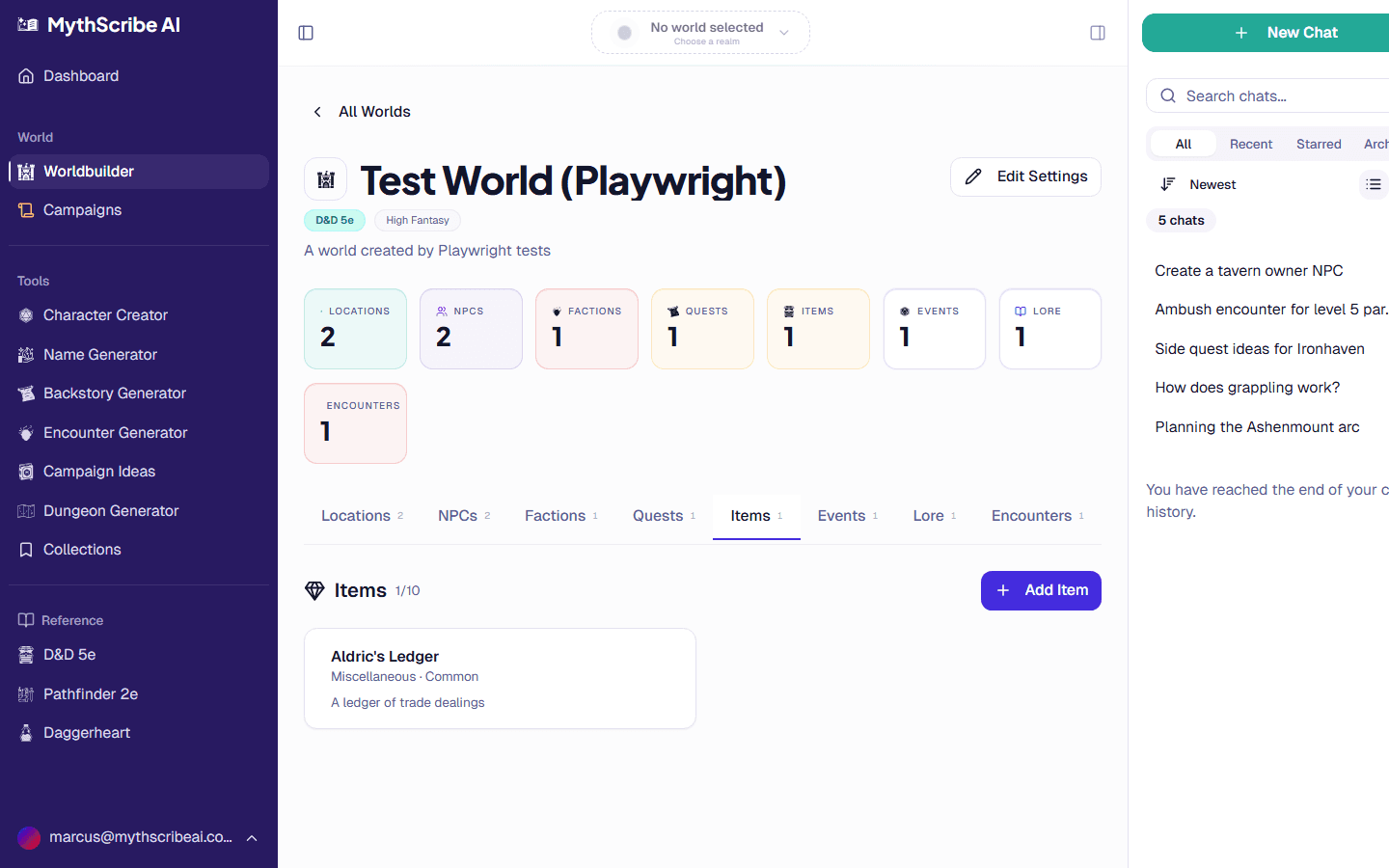 Worldbuilder items tab showing magic items with rarity badges
This is especially useful for campaigns with recurring items. If the party sells a cursed artifact, you know exactly where it went and can bring it back when the story calls for it.
Magic Items by Rarity
When stocking a dungeon or using a D&D loot generator, it helps to know the rarity tiers and their approximate value. The DMG provides suggested price ranges, and Xanathar's Guide expands on them:
| Rarity | Price Range | Example Items |
|---|---|---|
| Common | 50-100 gp | Potion of Healing, Cantrip spell scrolls |
| Uncommon | 101-500 gp | +1 weapons, Bag of Holding, Cloak of Protection |
| Rare | 501-5,000 gp | +2 weapons, Flame Tongue, Ring of Protection |
| Very Rare | 5,001-50,000 gp | +3 weapons, Staff of Power, Tome of Understanding |
| Legendary | 50,001+ gp | Vorpal Sword, Holy Avenger, Ring of Three Wishes |
As a general rule: common and uncommon items are appropriate for tiers 1-2 (levels 1-10), rare items start appearing in tier 3 (levels 11-16), and very rare and legendary items belong in tier 4 (levels 17-20). Giving a Flame Tongue to a level 3 party won't break the game immediately, but it will make encounter balancing much harder for the next several levels.
The DMG tables handle this scaling automatically. A D&D loot generator that respects CR-based rarity caps will keep your economy intact while still making treasure exciting.
FAQ
How does D&D loot work?
When the party defeats enemies or discovers treasure, the DM determines what they find. The DMG provides random treasure tables organized by challenge rating — roll dice, check the table, and hand out the results. DMs can also place specific items deliberately or use a dnd loot generator to create treasure tailored to the encounter.
What's the difference between individual treasure and hoard treasure?
Individual treasure is what a single creature carries — pocket change, a weapon, maybe a minor trinket. You roll it per monster. Hoard treasure is the accumulated wealth of a lair, vault, or boss monster. It includes much larger gold quantities plus magic items. You typically roll hoard treasure once per dungeon or major encounter.
Can I use AI to generate D&D loot?
Yes. AI tools like the MythScribe Chat can generate loot that's tailored to your specific encounter — matching the enemy type, dungeon theme, party level, and story context. This goes beyond what static tables offer. You can ask for cursed items, quest hooks embedded in treasure, or full hoard descriptions with history and flavor text. Combine it with the Encounter Generator to build encounters and loot together.
Try These Tools Free
Put what you just read into practice.